

My family and I tried to cut wine and liquor bottles in half, cleanly, to make candles and similar projects. It turned out to be super hard. That got me wondering what happens to a wine bottle when you do not turn it into a candle holder, and I was today days old when I learned that wine and liquor bottles are recycled more often than the average glass container in the U.S. They are still far from a success story.
How many get recycled
The EPA's newest glass numbers on its materials page are for 2018, so that is the year used throughout this post. Source: EPA, Glass: Material-Specific Data. The by-bottle breakdown is in the EPA's 2018 data tables. Source: EPA, Facts and Figures 2018, Table 6.
- All glass containers: 9.79 million tons generated, 3.06 million tons recycled, a 31.3% recycling rate.
- Wine and liquor bottles: 1.81 million tons generated, 720,000 tons recycled (39.8%).
- The rest of the wine and liquor bottles: 210,000 tons burned for energy (about 12%) and 880,000 tons landfilled (about 49%). Those two percentages are my arithmetic from EPA's tonnage columns.
One number often repeated online puts wine bottles at around 15%. In the EPA's table, 15.0% belongs to the "other bottles and jars" row, the pickle-and-pasta-sauce category. Wine and liquor bottles come in near 40%.
The second lives of a wine bottle
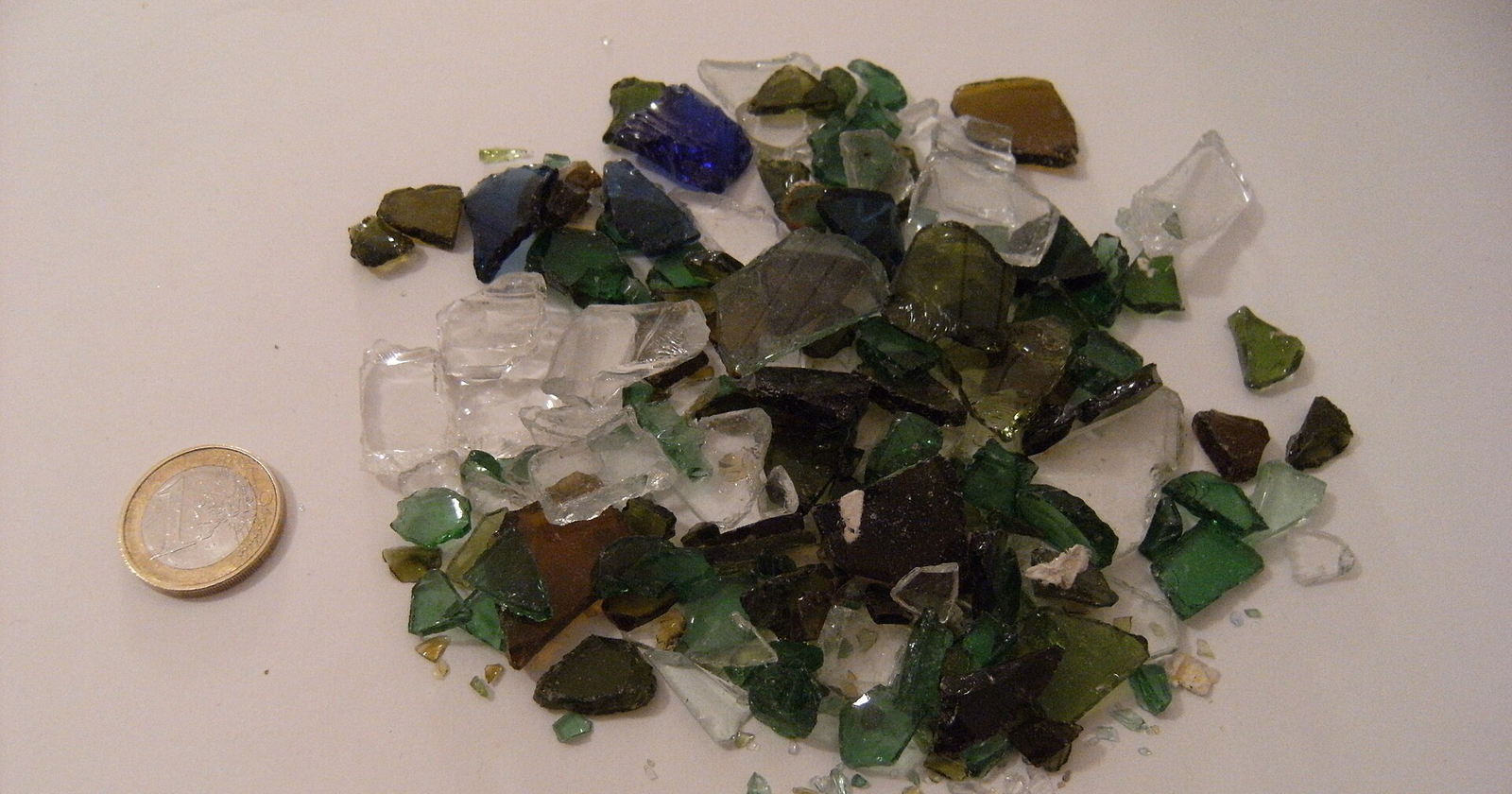
| Second life | What happens |
|---|---|
| New bottles and jars | Crushed glass, called cullet, goes back into the furnace. Every 10% of cullet in the mix lowers furnace energy by about 2–3%, and one ton of carbon dioxide is avoided for every 6 tons of recycled container glass. Only glass containers can be remade into food and drink containers. Source: Glass Packaging Institute, Industry FAQ. |
| Fiberglass insulation | The glass container and fiberglass industries together buy about 3.35 million tons of recycled glass a year, according to GPI, which does not break out how much goes to each. Source: Glass Packaging Institute, Industry FAQ. |
| Road base, fill and sand | A Federal Highway Administration guide says properly sized crushed glass can behave like gravel or sand and should suit road base or fill. That guide dates from 1997. Source: FHWA, Waste Glass user guidelines. |
| Sand for sandbags and coasts | Glass Half Full in New Orleans pulverizes glass into sand and gravel, fills sandbags with it, and says its ultimate goal is to help rebuild Louisiana's eroding coast. That is a stated goal, not a finished project. Source: Glass Half Full. |
| Landfill or incinerator | In 2018, about 61% of wine and liquor bottles, by weight, ended up here (880,000 tons landfilled plus 210,000 tons burned, out of 1.81 million). Source: EPA, Table 6, my arithmetic. |
Why a bottle in your bin may not make it
Most U.S. curbside programs are single-stream, meaning glass rides in the same bin as paper, plastic and cans. The Glass Packaging Institute says only 40% of glass collected that way is actually accepted at the sorting facility. Source: Glass Packaging Institute. The Container Recycling Institute adds that glass shards can contaminate paper loads and wreck a paper mill. Source: Container Recycling Institute.
Where glass is kept separate, the results look different. In the 10 U.S. states with deposit laws, GPI says glass recovered through deposits is double, sometimes triple, the amount recovered from single-stream, and yields three times more clean cullet. It also cites the Container Recycling Institute for a glass container recycling rate of over 63% in deposit states against about 24% elsewhere. Source: GPI, How Deposit Return Impacts Glass Recycling, GPI Industry FAQ.
Even then, wine is not always covered. Going by the Container Recycling Institute's state pages:
- Wine and liquor bottles are in the deposit system in California, Iowa and Maine.
- Vermont covers liquor bottles over 50 mL but not wine. Source: Bottle Bill Resource Guide.
- Hawaii and New York list wine as not covered. Sources: Hawaii, New York.
- Oregon leaves out distilled spirits and wine in most containers, and added canned wine in 2025. Source: Bottle Bill Resource Guide.
I did not check the other three bottle-bill states for wine coverage.
How Europe compares
The EU recycled 75.1% of its glass packaging in 2024, by Eurostat figures reported by the industry group Close the Glass Loop. Belgium reported 98%, Slovenia 97% and Luxembourg 90%. Source: Close the Glass Loop.
A separate Close the Glass Loop measure, how much glass packaging is collected for recycling, reached 82.2% in 2024, and the glass recyclers' federation estimates 85% of what is collected is recycled back into glass in a closed loop. Source: Close the Glass Loop. I did not find a study that explains the gap with the U.S., so I will not guess. For scale, the Glass Packaging Institute's own goal is to raise the U.S. rate to 50% over the next 10 years. Source: Glass Packaging Institute.
Sidebar: why a bottle cracks where it wants to
A glass cutter does not slice glass. It scratches a score line that weakens the surface, and the glass then breaks along that weak line. Glass cutters are built mainly for flat sheets, and sources note that tempered glass shatters instead of breaking cleanly. Source: Wikipedia, Glass cutter.
The popular heat-and-cool trick for bottles uses thermal shock. When one part of the glass changes temperature faster than the rest, the parts expand by different amounts, and when that strain exceeds the glass's tensile strength it cracks. Source: Wikipedia, Thermal shock. Glass that was not slowly cooled when it was made can also hold leftover stress that makes it crack on small temperature changes. Source: Wikipedia, Annealing (glass).
Why that is harder on a round bottle than on a window pane is my reading, not something I found a source for: the score line has to run around a curve, and any weak spot or built-in stress can pull the crack off your line. These are general references, not a bottle-cutting study.
The DIY reality, and reuse as is
If cutting is a coin flip, an uncut bottle is the safer craft. A few ways to reuse one whole, which are my own ideas rather than researched facts: a vase for one or two stems, a taper candle holder using the neck, a water or oil carafe after a good wash, or a garden edging. If you do try cutting, wear eye protection and gloves, and expect sharp edges that need sanding.
One more option from the recycling world: the Container Recycling Institute says refillable glass bottles can be reused 20 or more times. Source: Container Recycling Institute. For wine, that mostly does not exist in the U.S. yet, but it is where a bottle could have the longest life of all.
So the answer to the title is: about four in ten go back into the glass loop, and the rest quietly end up somewhere else, most of them in a landfill or an incinerator. And cutting one in half, as we found out, is harder than it looks.