
I got asked a blunt question: did the sugar industry, with Harvard's help, send the United States into the obesity crisis? There really is a paper trail behind that question, and it is worth reading. It just points somewhere narrower than the question does.
The short version: in 1965 the sugar industry secretly paid two Harvard nutrition researchers to review the evidence on sugar and heart disease, and the 1967 journal articles that came out of it never said who paid. That is documented. What is not documented is that it made America fat. The review was about heart disease, and obesity barely moved for another decade after it ran.
The Paper Trail
In 2016, researchers at the University of California, San Francisco, published a historical analysis in JAMA Internal Medicine. Cristin Kearns, Laura Schmidt and Stanton Glantz went through 346 archival documents, mostly letters kept in the papers of a University of Illinois chemist who advised the Sugar Research Foundation (SRF, the trade group now called the Sugar Association), plus 27 from the papers of Harvard's D. Mark Hegsted. Here is the sequence they pieced together:
- 1954: The paper reports that the SRF's president saw a business opportunity in Americans moving to lower-fat diets, since sugar would then supply more of their calories.
- December 14, 1964: John Hickson, the SRF's research director, wrote to a colleague that the foundation "could embark on a major program" to counter John Yudkin, a British scientist who argued sugar mattered more than fat in heart disease, and other "negative attitudes toward sugar."
- July 13, 1965: The SRF's executive committee approved "Project 226," a literature review titled "Carbohydrates and Cholesterol Metabolism." Hegsted and Robert McGandy would write it, with Harvard nutrition department chair Fredrick Stare overseeing. The SRF would pay them $6,500, which the paper puts at about $48,900 in 2016 dollars.
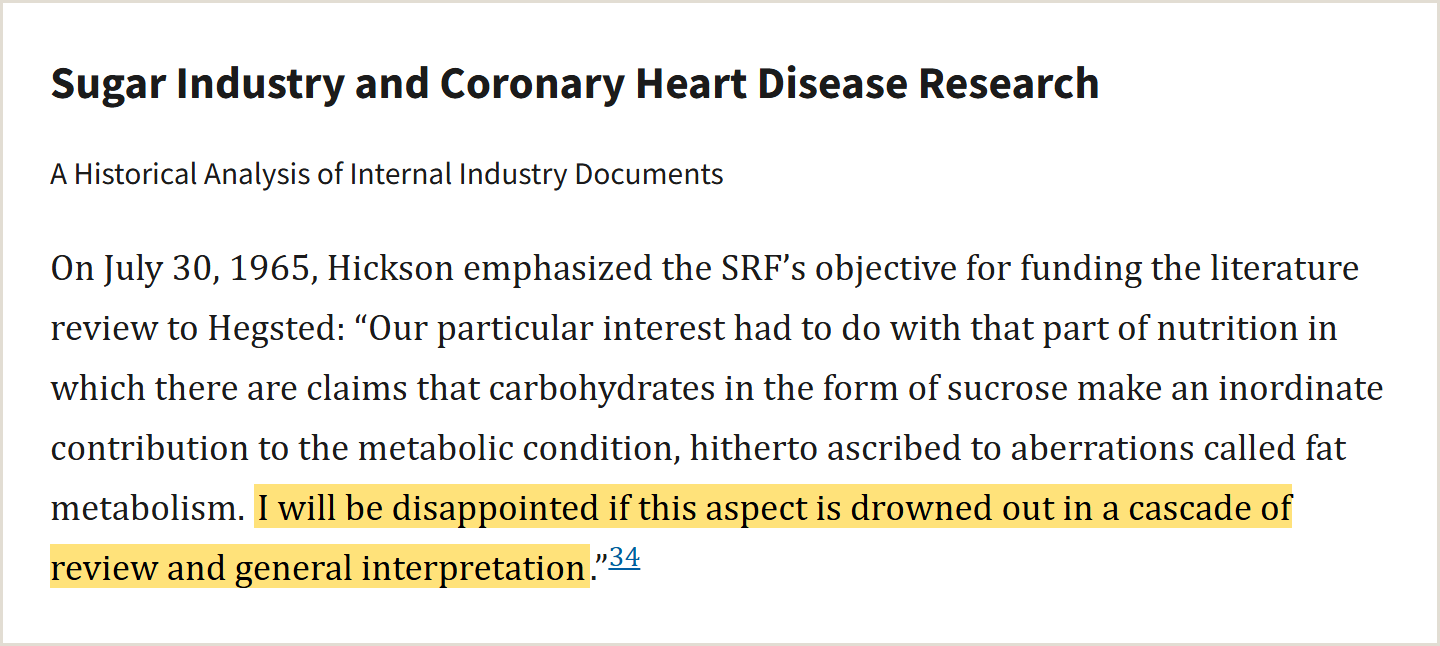
- July 30, 1965: Hickson told Hegsted what he was after: "Our particular interest had to do with that part of nutrition in which there are claims that carbohydrates in the form of sucrose make an inordinate contribution to the metabolic condition, hitherto ascribed to aberrations called fat metabolism. I will be disappointed if this aspect is drowned out in a cascade of review and general interpretation."
- August 10, 1965: Hegsted replied: "We are well aware of your particular interest in carbohydrate and will cover this as well as we can."
- Later: Hickson saw drafts, and after reading the finished one he wrote that it was "quite what we had in mind and we look forward to its appearance in print."
- July 27 and August 3, 1967: The New England Journal of Medicine ran the review in two parts, "Dietary fats, carbohydrates and atherosclerotic vascular disease," by McGandy, Hegsted and Stare. The authors disclosed other industry funding for their lab research. They did not disclose the SRF's role.
(One small wrinkle: the paper's own text and its reference list disagree on the date of the "quite what we had in mind" letter, so I have left the date off.)
What the Review Said
The review concluded there was "no doubt" that the dietary change needed to prevent coronary heart disease was lowering cholesterol and swapping polyunsaturated fat for saturated fat. It gave sugar a much smaller role. Along the way it discounted the studies that pointed at sugar, including Yudkin's, "on the grounds that they contained questionable data or incorrect interpretation," the 2016 paper says.
It matters what the review did not say. It was not about weight. It was an argument about whether sugar or fat was the bigger problem for the heart.
Who Was Actually Paid
The popular retellings blur this, so here it is carefully:
- The review had three authors: McGandy, Hegsted and Stare.
- The documents show two being paid: Hegsted and McGandy, $6,500 between them for the project.
- Stare is documented as overseeing the project and as an ad hoc adviser to the SRF. The paper does not say he received any of the $6,500.
- I could not establish whether the money went to the two men personally or through Harvard. Nothing I found shows Harvard as an institution taking the money, so "Harvard was paid" goes further than the documents.
The amount was not lavish for a year-long research project, and a few thousand dollars is not a "bribe" in the usual sense. The problem was the secrecy. Readers of the NEJM in 1967 had no way to know the people judging sugar had been hired by the people selling it.
How It Came Out
The paper appeared on September 12, 2016. The Sugar Association's response, reported by STAT, was to say it "should have exercised greater transparency in all of its research activities," while calling it "challenging" to comment on events from about 60 years ago and on documents it had never seen, and adding that "sugar does not have a unique role in heart disease." The NEJM said it now asks authors to report financial conflicts from the previous 36 months and "plans to take no action" on the 1967 articles.
Walter Willett, then chair of Harvard's nutrition department, spoke for himself and not the university. He called Hegsted "a very hard nosed, data driven person, who had a record for standing up to industry interests," and said, "I very much doubt that he changed what he believed or would conclude based on industry funding." But he added that taking the money "put him in a position where his conclusions could be questioned," and that such relationships "could induce some subtle bias, even if unconscious."
What Is Contested
- There is no proof the SRF changed the text. The authors say so themselves: "There is no direct evidence that the sugar industry wrote or changed the NEJM review manuscript," and their case that it shaped the conclusions "is circumstantial." The strong claim is hidden sponsorship plus a funder who stated what it hoped to see, not ghostwriting.
- Historians disagree about the "conspiracy" label. In Science in 2018, Johns and Oppenheimer argued that the archives do not show a sugar conspiracy. Kearns and colleagues replied that the critique leaned on news stories and press releases rather than their peer-reviewed papers.
- The fat conclusion held up. A 2020 Cochrane review found that cutting saturated fat for at least two years lowered combined cardiovascular events by about 17% (risk ratio 0.83) across 12 trials and 53,758 people. So the review was not wrong that fat matters. What was wrong was the secrecy, and the way the sugar studies were waved off.
- Nobody has measured how much it mattered. One review among many in the 1960s, from a field full of people who already suspected fat. I found no study that traces national advice back to it.
The Obesity Reality Check
Now the question you actually asked. The best US numbers come from federal health surveys that measure height and weight. They show:
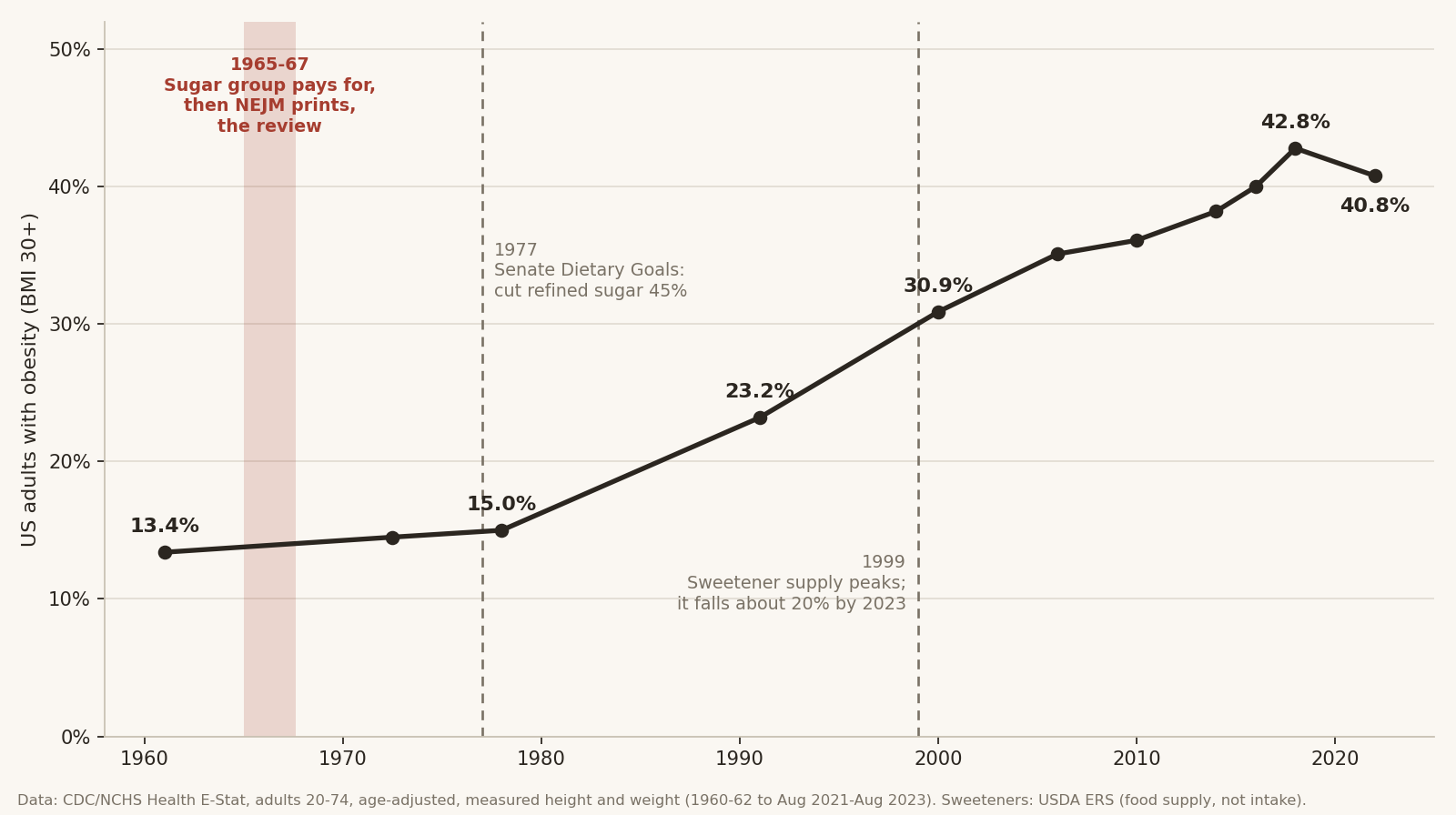
- 1960-62: 13.4% of adults had obesity.
- 1976-80: 15.0%. That is nearly flat across the years of Project 226, the 1967 review and the first years after it.
- 1988-94: 23.2%.
- 1999-2000: 30.9%.
- 2017-18: 42.8%, and 40.8% in the August 2021 to August 2023 survey.
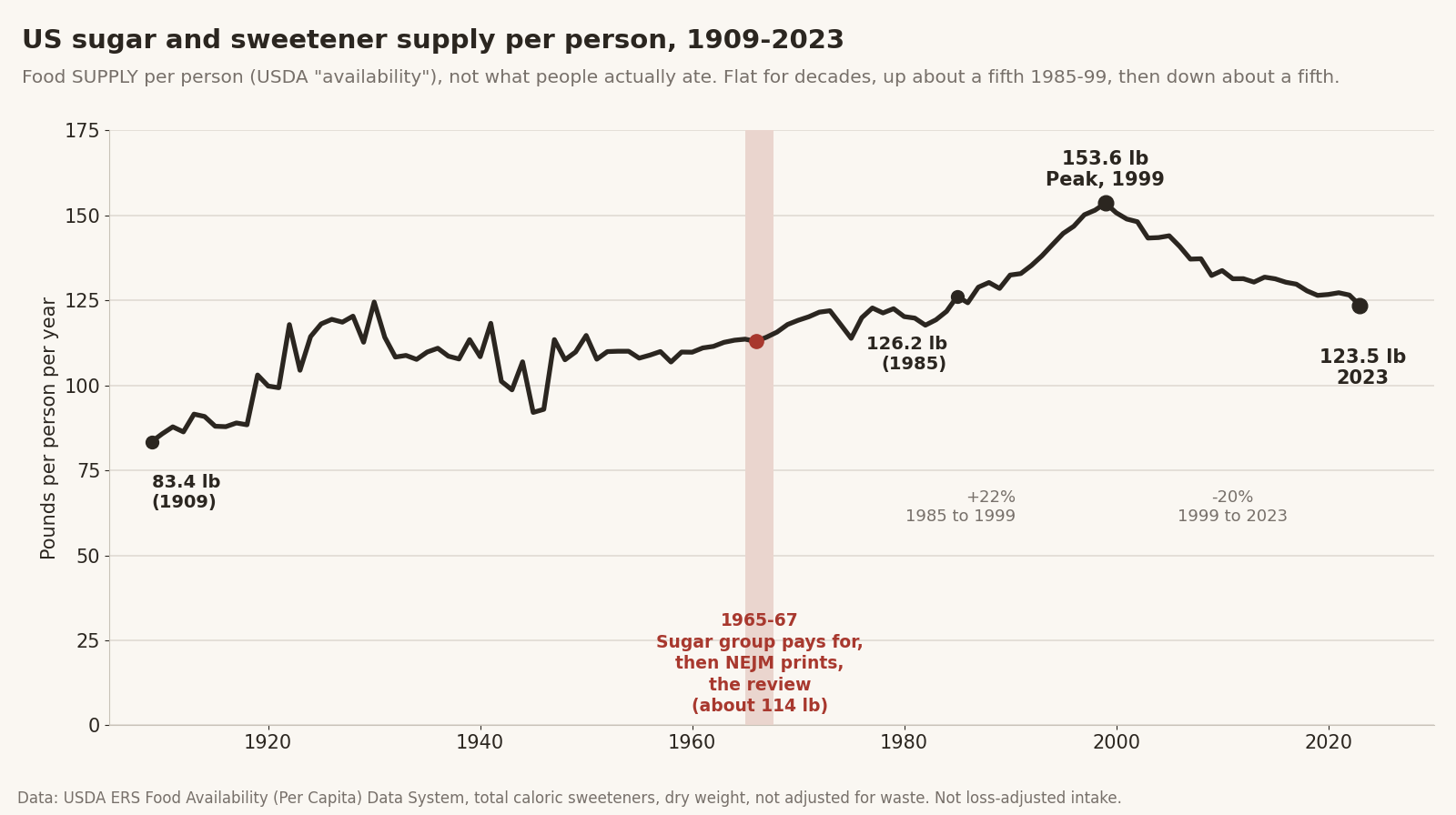
The take-off came after 1980, which is hard to pin on a 1967 journal article. Two more facts cut against a simple sugar-did-it story. First, according to the USDA's economists, the sugar and sweetener supply per American peaked in 1999 at 153.6 pounds a year and fell about 20% by 2023, to 123.5 pounds. That is food supply, not what people ate, but obesity kept climbing for almost two more decades. Second, it is not just an American story. A pooled analysis of 200 countries in The Lancet found obesity in men worldwide rising from 3.2% in 1975 to 10.8% in 2014, and in women from 6.4% to 14.9%.
Here is that supply over the whole record the USDA keeps, which starts in 1909.
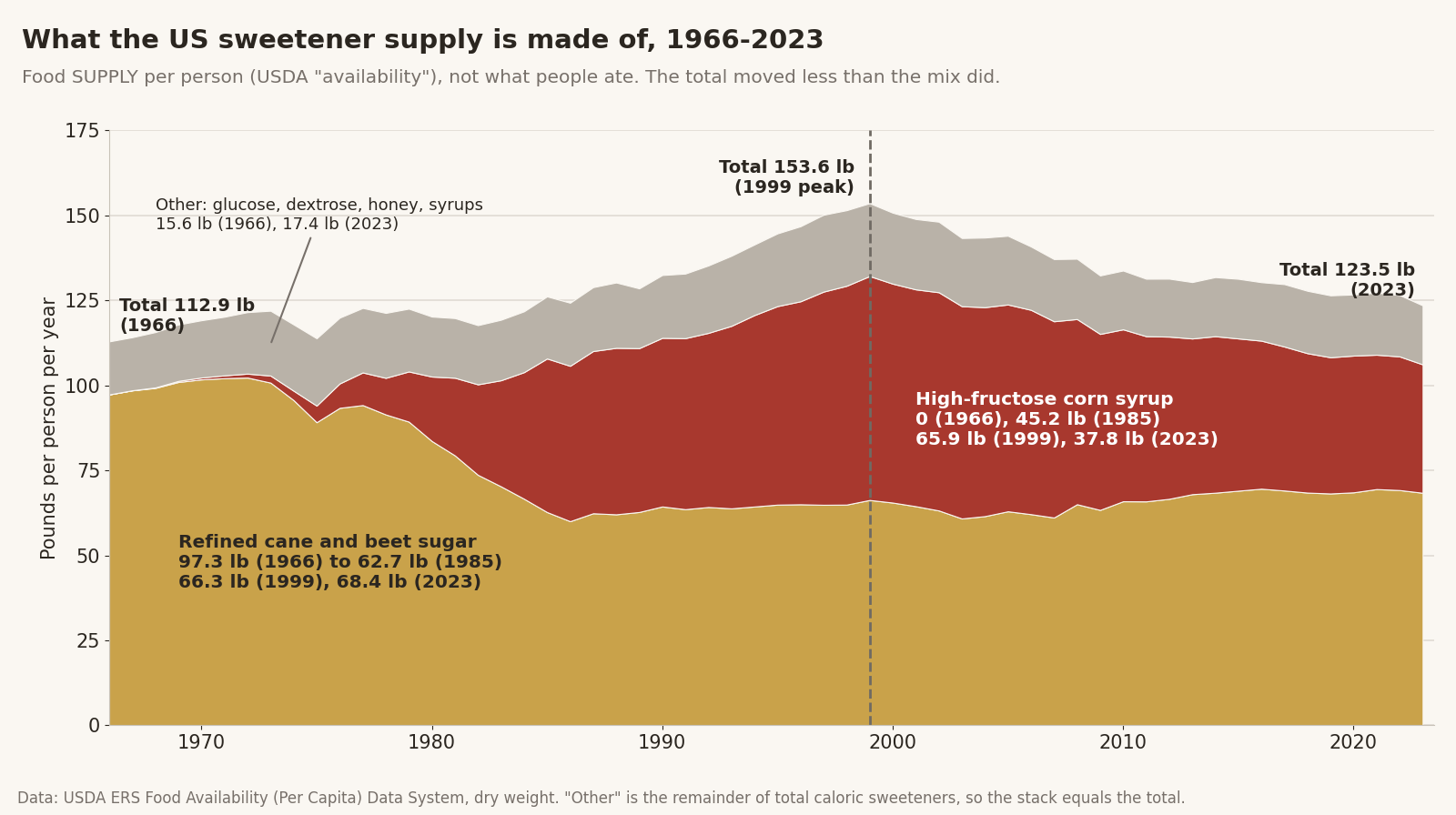
The total hid a bigger change underneath: what the supply was made of.
The calorie numbers also complicate the low-fat story. According to CDC data on what Americans said they ate, men went from about 2,450 to 2,618 calories a day and women from about 1,542 to 1,877 between 1971-74 and 1999-2000, mostly from carbohydrates. The share of calories from fat dropped, but only because the total grew: men's fat intake fell by about 5 grams and women's rose by about 6.5.
Sugar, especially in drinks, is a legitimate suspect in rising weight. So are cheap calories, processed food, portion sizes and less movement, and researchers argue about how much each counts. Nothing I found lets anyone assign a share to one paper from 1967.
What Happened Next
Here is the twist I did not expect. Hegsted went on to a much bigger stage, and the documents show him pushing for less sugar.
- January 1977: Hegsted was one of four outside consultants on the Senate's Dietary Goals for the United States. At the press conference he said, "The diet of the American people has become increasingly rich — rich in meat, other sources of saturated fat and cholesterol, and in sugar."
- December 1977: The second edition told Americans to "reduce the consumption of refined and other processed sugars by about 45 percent" to about 10% of their calories. It also told them to cut fat from about 40% to 30%, and added a new first goal: "to avoid overweight, consume only as much energy (calories) as is expended."
- 1978 to 1982: Hegsted took leave from Harvard to run a new human nutrition program at the U.S. Department of Agriculture, according to the National Academy of Sciences memoir. (Sources give the job title differently.)
- 1980: The first Dietary Guidelines for Americans, issued by USDA and the Department of Health and Human Services, included "avoid too much sugar" alongside the advice on fat.
So the man who took the sugar industry's money in 1965 helped write a government goal in 1977 that asked Americans to eat far less sugar. That does not clear the 1967 episode, since secret funding is a problem whatever the conclusion. But it breaks the cartoon in which the paid scientist spares sugar for life.
Did anyone say sorry? Stare died in 2002 and Hegsted in 2009, years before the 2016 paper came out. I could not find a public statement by Hegsted about the SRF payment, in either direction. I also could not confirm what McGandy said or when he died.
So, Did They Send America Into Obesity?
Documented: The sugar industry secretly paid for a favorable 1967 review, picked its angle, saw drafts, and the journal did not disclose it. The authors' own paper calls the evidence that it shaped the conclusions "circumstantial."
Plausible, unproven: That the episode nudged the debate away from sugar and toward fat, and that food makers then reformulated toward low-fat, high-sugar products.
Not supported: That this paper, or sugar alone, caused the obesity epidemic. The timing is wrong, the review was about hearts, and the rise is worldwide.
The defensible headline is smaller and, to me, more useful: hidden sponsorship can bend which question a field asks, and in 1967 nobody had to tell you who paid.
And the man the foundation wanted countered in that 1964 memo? That was John Yudkin, the London scientist whose book Pure, White and Deadly told the other side. His story is the scientist the industry wanted countered, and what he got right and wrong.